
Delaware Court Docket
The Delaware court docket gives the public a way to look up civil cases filed in state courts. Pull up a case by person, business, or type. The state runs the CourtConnect portal for court docket searches in the Superior Court, Court of Common Pleas, and Justice of the Peace Court. You can view party names, hearing dates, and filings from any device. If the file is not online, you visit the courthouse in the county where the case was filed. The Delaware court docket covers cases from all three counties: New Castle, Kent, and Sussex.
Delaware Court Docket Overview
How to Search the Delaware Court Docket
The Delaware Judiciary runs an official online case management system called CourtConnect. It is the main way to pull court docket info for most state trial courts. You can log in as a guest or set up an account for more features. The system covers civil dockets from Superior Court, Court of Common Pleas, and Justice of the Peace Court. Basic case data is free. Some document downloads may cost a fee.
The Delaware courts homepage links out to every court and every tool for public access. Start there if you are not sure which court has your case. The Delaware Courts website has maps, hours, and contact info for each court in the state.
Check the Delaware Courts homepage to get your bearings before you search.
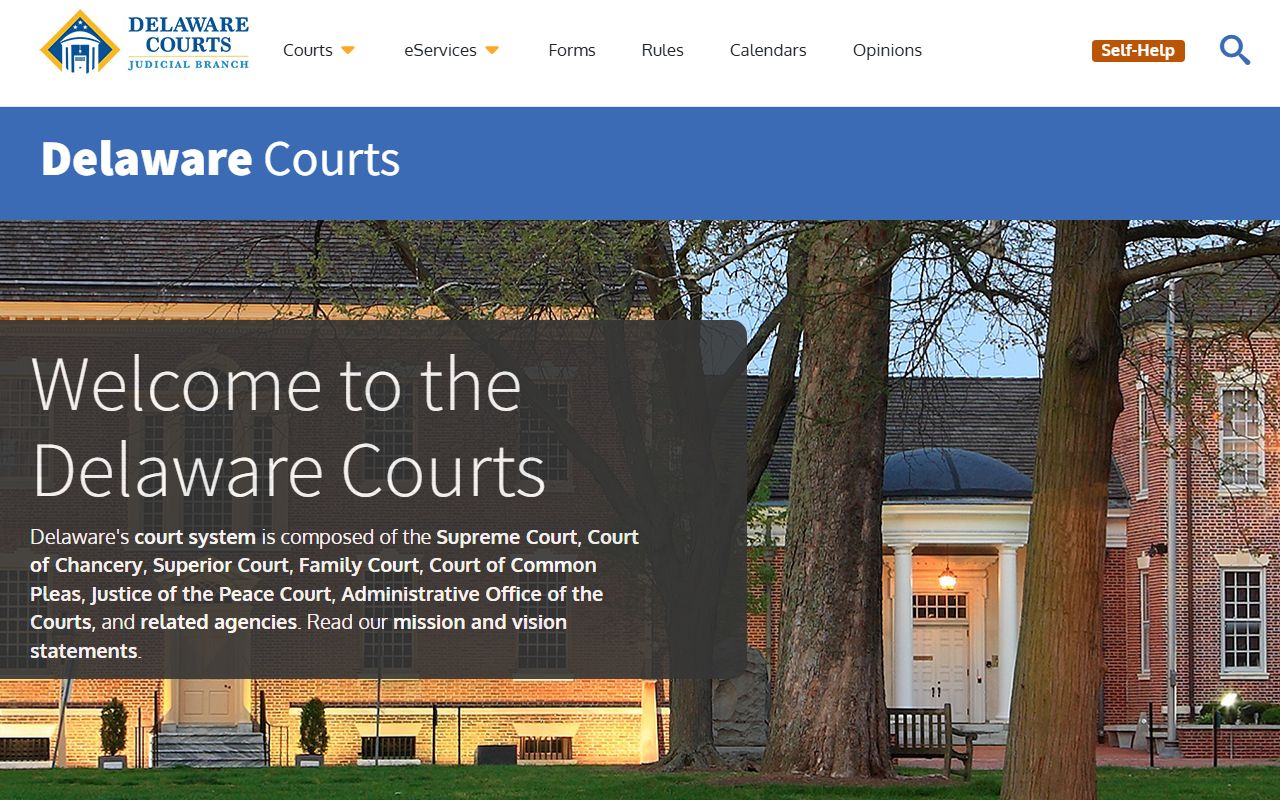
The homepage has quick links to each court level, plus forms, e-filing tools, and the public docket search. The navigation covers Supreme Court, Court of Chancery, Superior Court, Family Court, Court of Common Pleas, and Justice of the Peace Court.
To search the Delaware court docket through CourtConnect, you need a name, business, or case number. The system allows phonetic searches and partial last name searches. You can limit the results by date range using DD-MON-YYYY format.
Head to the CourtConnect portal for a direct search of Delaware court dockets.
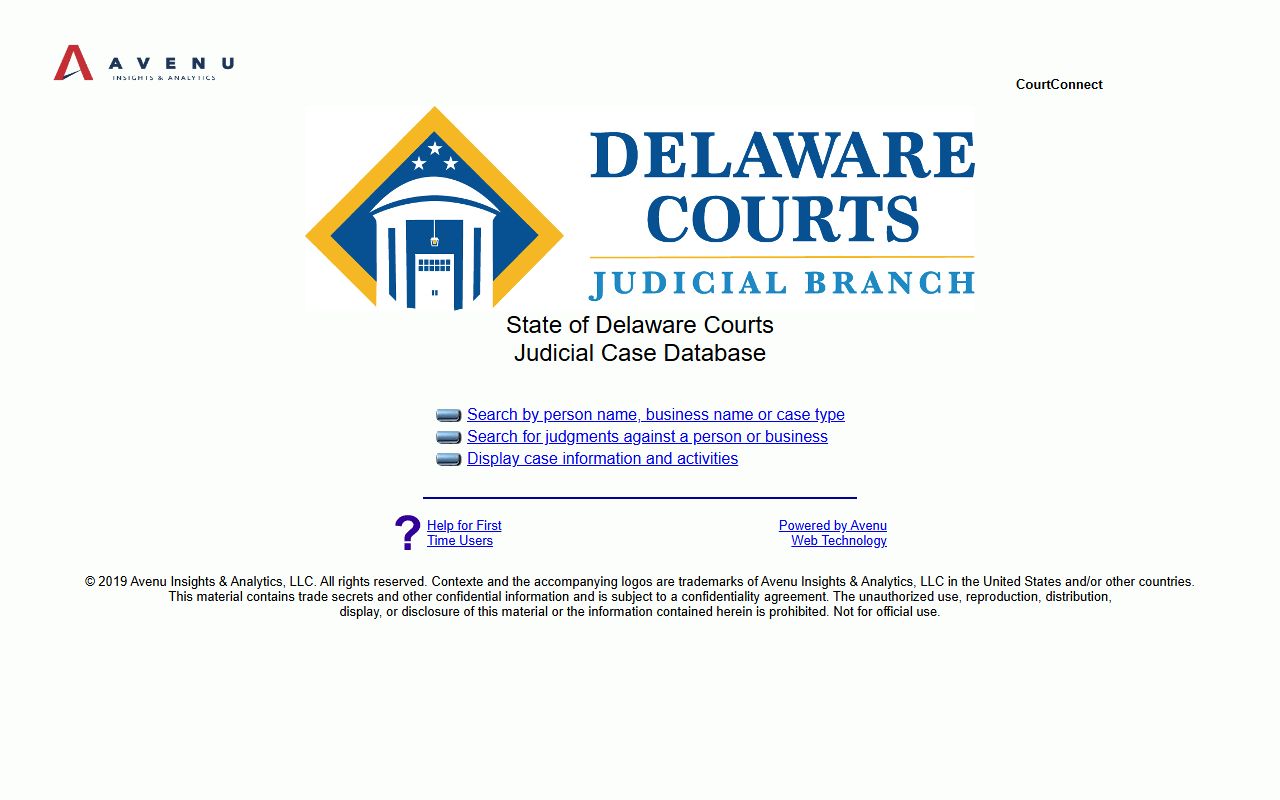
CourtConnect is powered by Avenu Insights and is the statewide tool for looking up civil court dockets. Each result shows party info, case status, and a chronological docket report. Family Court cases are restricted online due to privacy rules.
Note: CourtConnect gives basic case info for free, but not every document is online. Visit the courthouse for the full file.
Courts That Keep the Delaware Docket
The Delaware court system has multiple trial courts. Each one keeps its own docket and case files. The main trial courts in the state are the Superior Court, Court of Chancery, Court of Common Pleas, Family Court, and Justice of the Peace Court. Each court hears a set type of case.
The Superior Court is Delaware's court of general jurisdiction. It hears felony criminal cases and civil matters over $50,000. The court has offices in all three counties. You can search the civil docket online through CourtConnect, but criminal records may need a written request. For New Castle County, the Prothonotary line is (302) 255-0735. Kent County is (302) 735-1911. Sussex County is (302) 855-7055.
Visit the Superior Court page for full details on case types, forms, and fees.
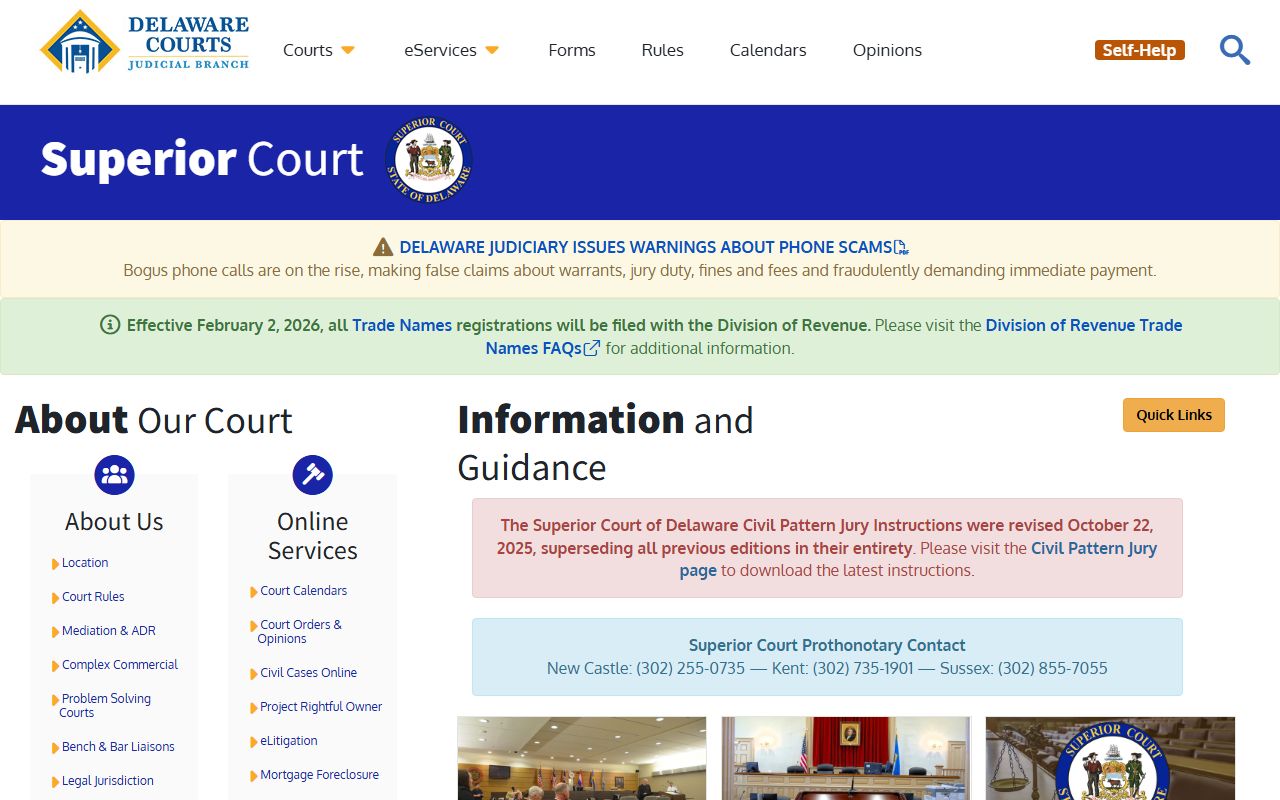
The Superior Court page links to the Prothonotary for each county, the eFiling system, court forms, and the records access policy. Case retrieval fees may apply for certified copies.
The Court of Chancery is Delaware's equity court. It handles corporate governance, trusts, guardianships, and injunction cases. Delaware's name in corporate law rides on this court. Published opinions and case files are kept at the Register in Chancery in each county. The Court of Chancery page has jurisdiction details, filing info, and fee rules.
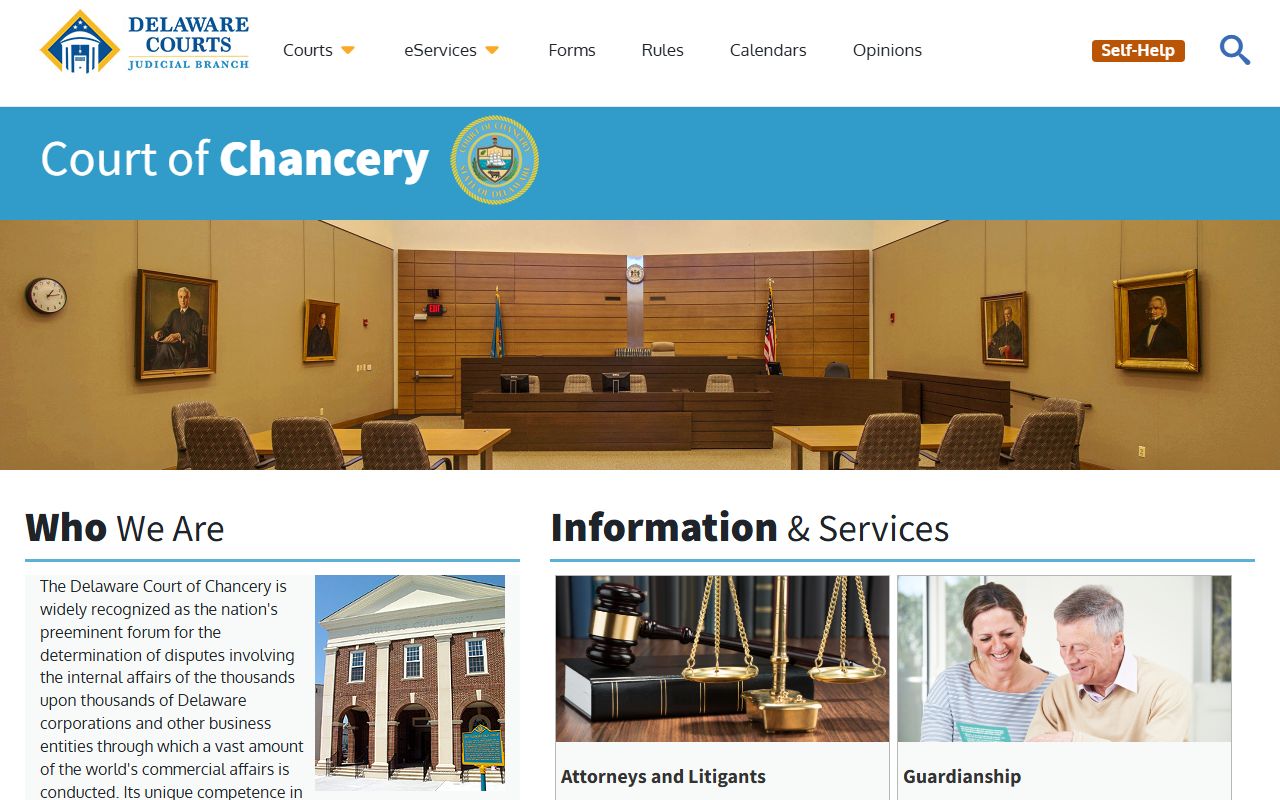
The Court of Chancery uses File and ServeXpress for e-filing. The filing fee for a new case starts at $410. All documents must be in Times New Roman, 14-point font, per the court's rules.
The Court of Common Pleas handles misdemeanors, civil cases up to $50,000, traffic violations, and appeals from the JP Court. Each county has its own location. The Court of Common Pleas page has contact info and e-filing links.
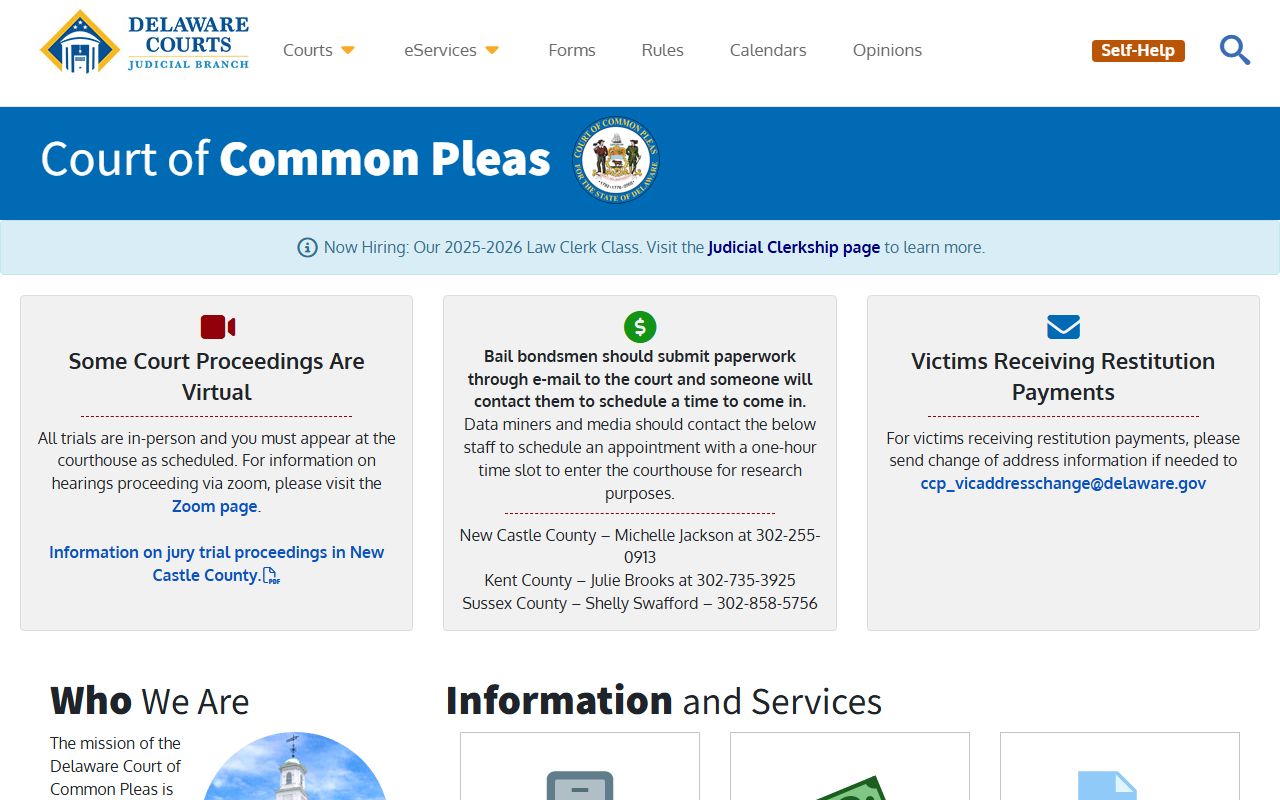
The Court of Common Pleas uses the eCourtPlus system for case management. Civil docket info is open through CourtConnect. Criminal files need a written request to the Clerk.
The Justice of the Peace Court is a limited-jurisdiction court. It hears civil cases up to $25,000, landlord-tenant disputes, small claims, minor crimes, and traffic cases. JP Courts are not courts of record under 10 Del. C. § 1301, so appeals go to the Court of Common Pleas for a full new trial.
Delaware Court Docket Access Online
The Delaware Courts keep a specific Civil Docket Search page for online access. The tool lets you search by person, business, case type, or judgments. You can build a date range and view full case activity. The Delaware Civil Case Search page is the simplest start point.
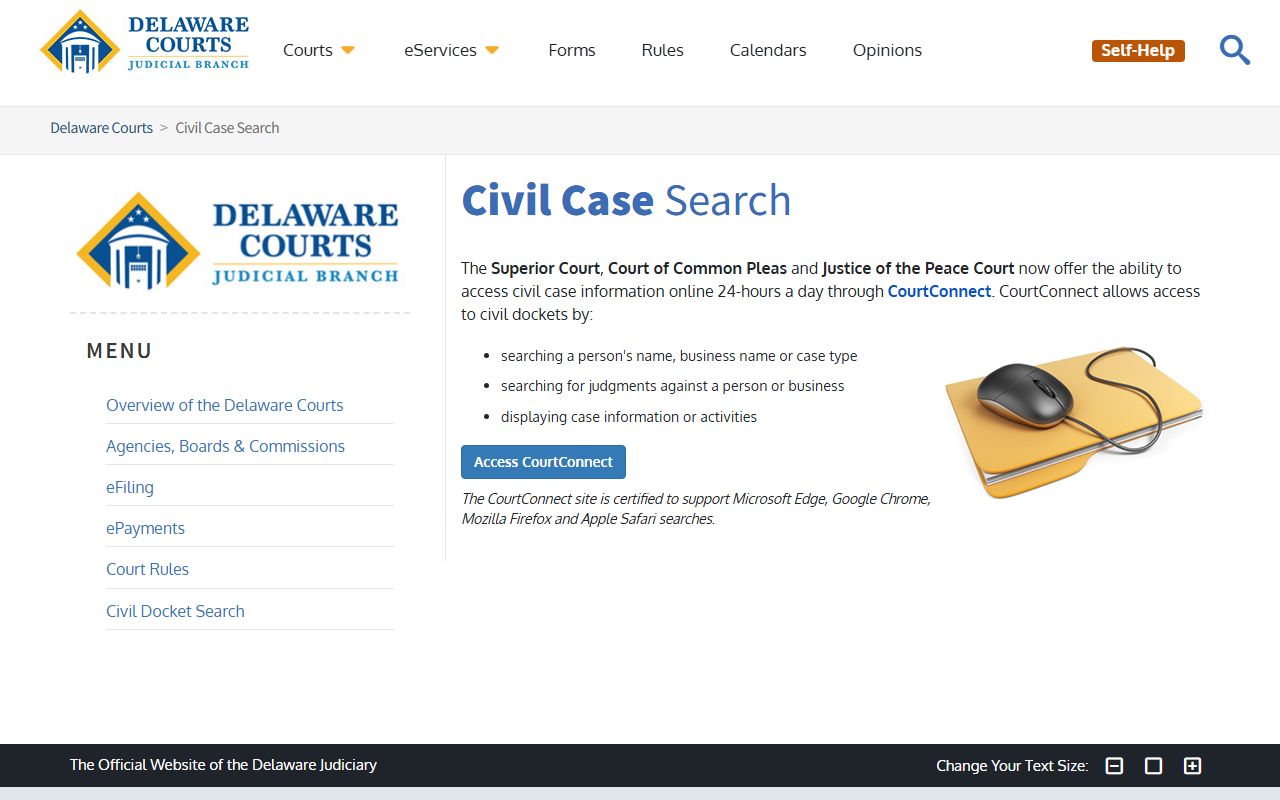
The civil case search covers Superior Court, Court of Common Pleas, and JP Court cases across Delaware. The page also lists the terms of use and limits on how records can be re-shared.
The Judicial Branch keeps a Policy on Public Access to Judicial Records. It spells out which records are open and which are held back. Civil case files and orders are open. Family Court records with minors are not. You can read the rules on the records access policy page.
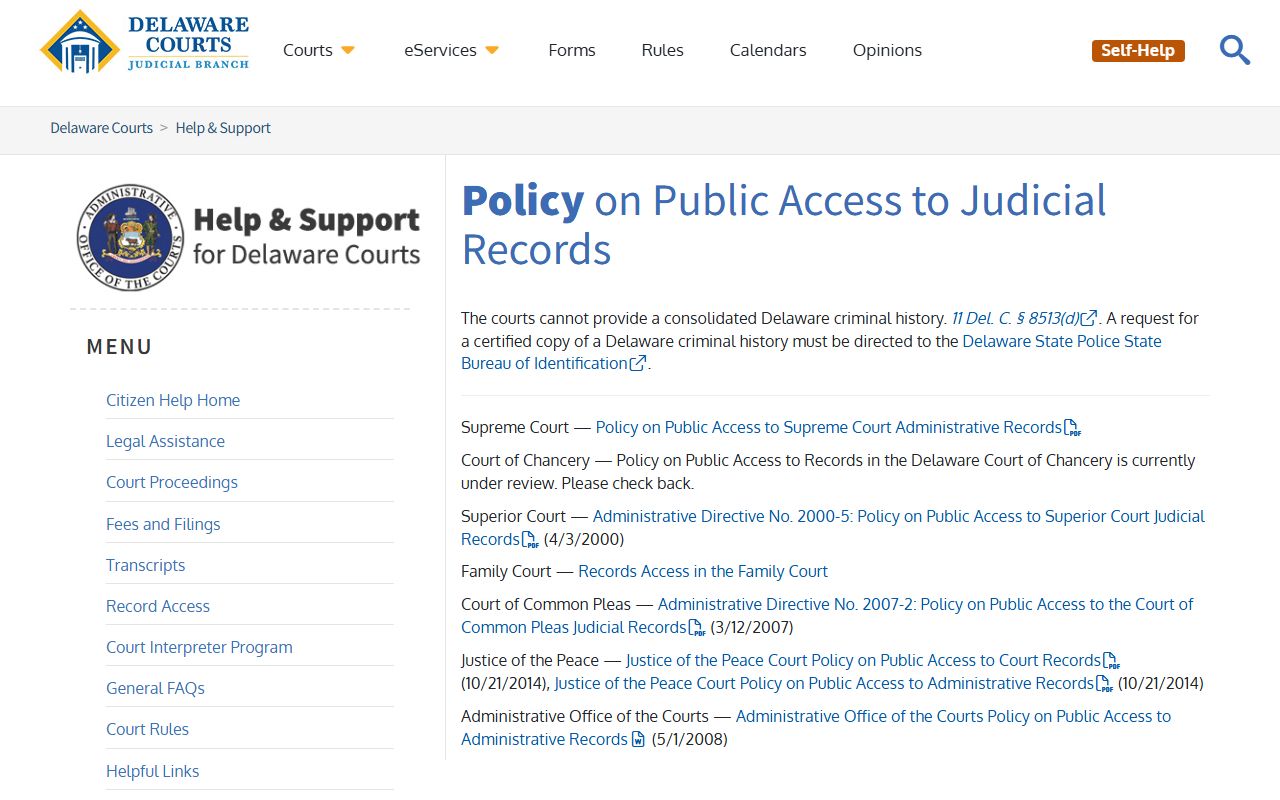
The policy page covers what is public, what is sealed, and how to ask for records not online. The courts set fees for certified copies and retrieval. Requests must go in writing to the court clerk.
Public access terminals are free at every courthouse. Staff can help you find a record, but they cannot give legal advice. Most clerks' offices are open Monday through Friday, 8:30 AM to 4:30 PM.
For federal cases tied to Delaware, use the PACER system at pacer.gov. The U.S. District Court for the District of Delaware sits in Wilmington and hears many patent and corporate cases. PACER charges $0.10 per page, with a $30 cap per document.
Types of Cases in the Docket
A Delaware court docket entry shows every step of a case. The docket lists filings, motions, orders, and hearing dates in order. For a civil case, the docket starts with the complaint and runs through the final judgment. For a criminal case, it shows the charge, each court date, and the sentence.
Most court dockets in Delaware include these items:
- Party names and attorney info
- Case type and filing date
- Motions, briefs, and responses
- Scheduled hearing dates
- Orders and judgments
- Case status and disposition
Civil judgments are indexed by the Prothonotary under 10 Del. C. § 2304. The office keeps two lists: one by plaintiff, one by defendant. Each judgment is indexed the same day it is entered. Judgment liens take effect from the hour and minute noted on the record.
Criminal records on the docket show the charge, the plea, the court's ruling, and the sentence. The docket itself is open to the public once the charge is filed. Some pre-charge records are sealed. The court cannot give you a full state criminal history, though. For that, you go to the State Bureau of Identification in Dover at 1407 N. DuPont Highway.
Delaware Court Records Access Rules
Delaware has its own set of rules for court records. The courts are not subject to the Freedom of Information Act. Under the Delaware FOIA, courts are left out of the "public body" definition. The state has put court access rules in place separately. The Attorney General's office keeps a page on open government at attorneygeneral.delaware.gov.
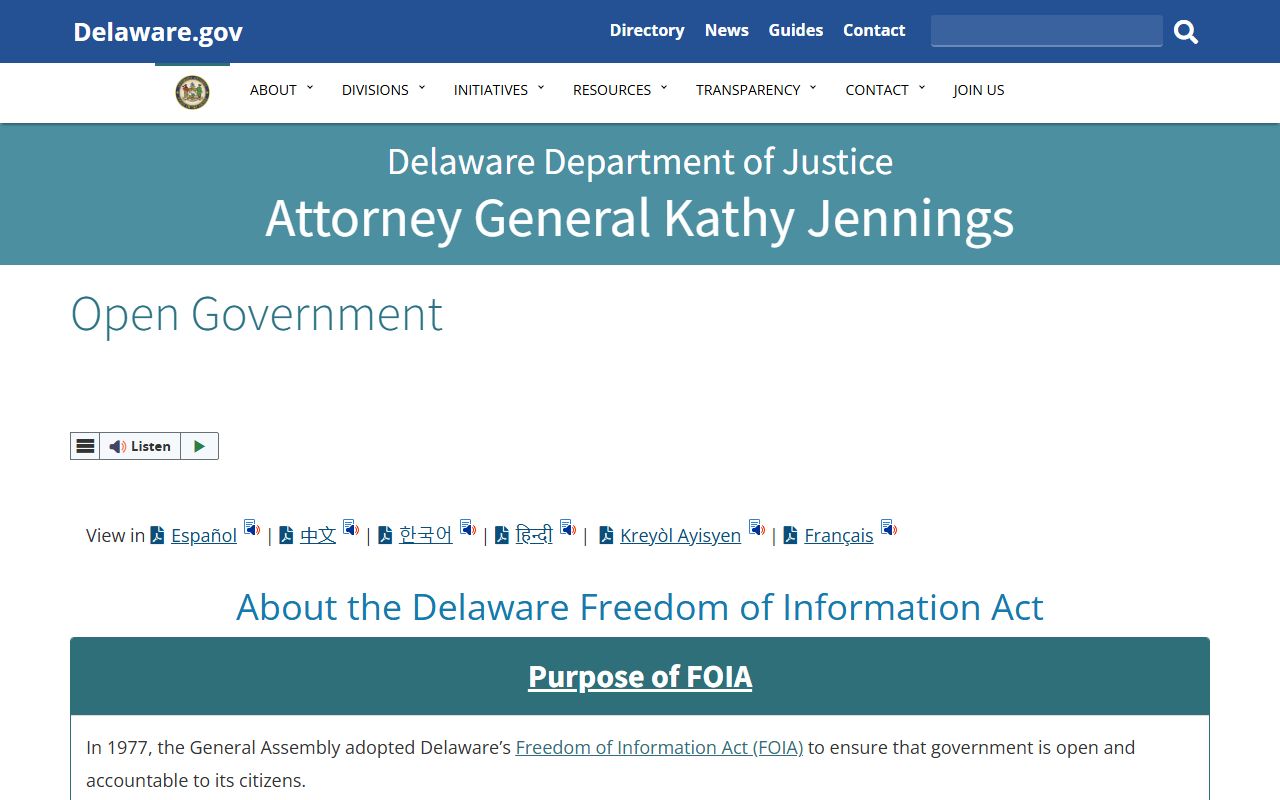
The page covers FOIA rules for state agencies, which can be handy when you need records from outside the court system. Agencies must reply within 15 business days. The first 20 black-and-white pages are free, then $0.10 per sheet after.
The FOIA statute itself is in Title 29, Chapter 100 of the Delaware Code. You can read it in full on the Delaware Code page. The law sets the purpose of open records and the duty of each public body to answer in writing.
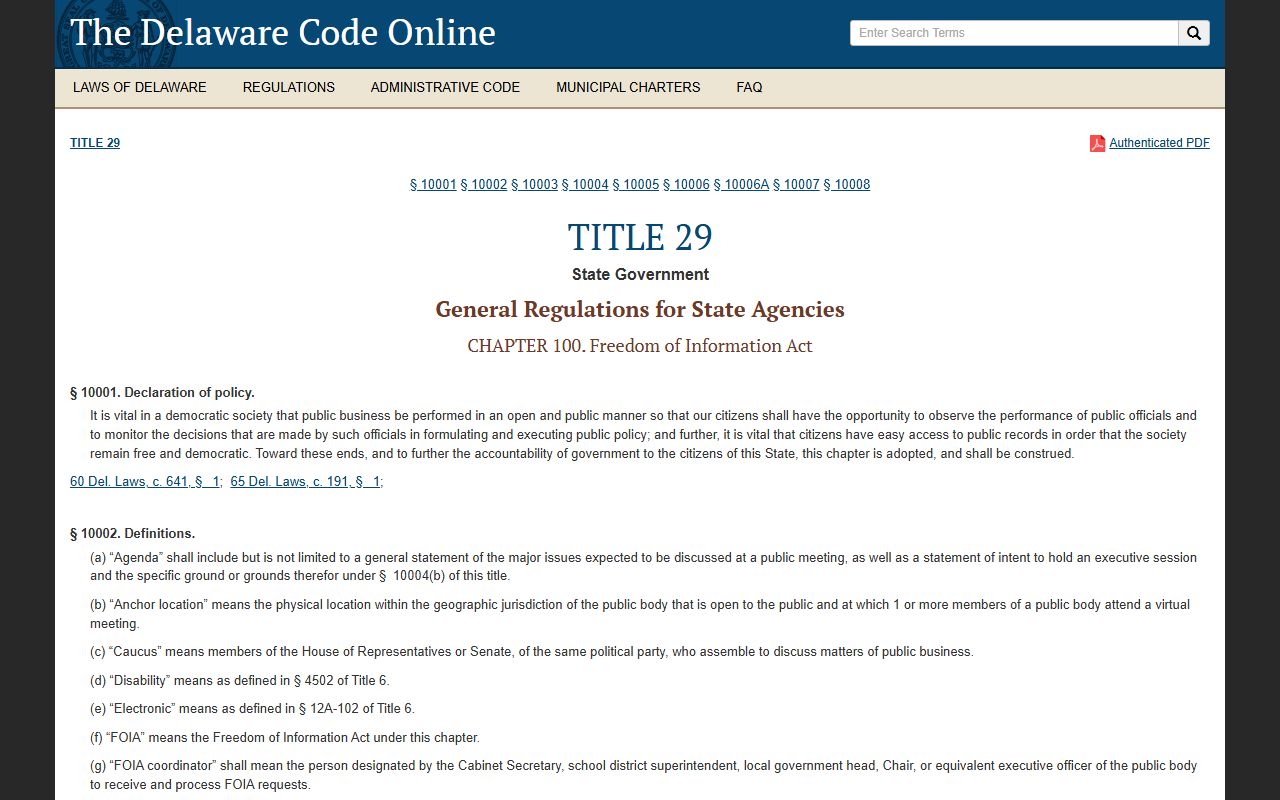
Title 29 lays out who counts as a public body, the form of a request, and the steps to appeal a denial. The Chief Deputy Attorney General reviews FOIA appeals for many state agencies.
For court records, the rules are in the judiciary's own policy. Under 10 Del. C. § 1911, the courts must keep records open during regular business hours. The law allows the courts to charge a fee to cover the cost of copies. You do not need to give a reason to look at a case file.
Records That Are Sealed: Family Court cases with minors, juvenile records, mental health cases, adoptions, and grand jury files are not open to the public. Records sealed by court order are also kept private.
Filing Fees and Court Docket Costs
The cost to file in Delaware depends on the court. The Superior Court charges $200 for a standard civil complaint. The Complex Commercial Litigation Division is $250. The fee covers the first 50 filings in a case. After that, you pay $245 for each new set of 50 filings.
Here are the fees you may run into when pulling Delaware court docket records:
- Superior Court certified copy: $15 for first three pages
- Extra pages: up to $2 per page
- Retrieval fee: $25 per record
- JP Court disposition record: $7
- JP Court certified civil copy: $10
- Audio recording CD: $25
Court of Chancery filings start at $410. The fee goes up based on case type and number of defendants. The office also charges $2 per page to docket each filing. The fee chart for Chancery is in Rule 3(bb).
Expungement petitions cost $75, regardless of which county you file in. The petition goes to the Prothonotary in the county where the case was resolved. Under Title 11, Chapter 43 of the Delaware Code, the petition must include a certified criminal history from the SBI no older than 45 days.
How to Request Records from the Delaware Docket
To get a copy of a file on the Delaware court docket, start with the court that heard the case. For the Superior Court, submit Form ADM_ADM_03_A, the Application for Access to Court Records. Send it by email, mail, or in person. Documents are held for pickup at the courthouse; they are not mailed or emailed.
For JP Court records, submit Form MISC35. Each court location keeps its own files, so the request goes to the specific JP Court where the case was heard.
Written requests must include case details. List the party names, the case number (if known), and the date range of the filing. The clerk needs enough info to find the record with reasonable effort. If you do not have a case number, CourtConnect can help you track one down.
Mail a check or money order with your request. The Prothonotary takes cash or check. No credit cards at the counter. For certified copies of Superior Court records in New Castle County, the email is nccproth@nccourts.de.gov. You can also send mail to 500 N. King St., Wilmington, DE 19801.
Older cases may have been moved to the Delaware Public Archives in Dover. The Archives are at 121 Martin Luther King Jr. Blvd N. For files from decades back, that is the place to start. Fees apply for research services.
Restricted Entries on the Delaware Court Docket
Not every case on the Delaware docket is open to the public. The court blocks certain records to protect minors, crime victims, and private data. Family Court cases with children are closed by default. Juvenile delinquency records are sealed when the subject turns 18 and destroyed at age 21.
Social Security numbers, bank accounts, and driver's license numbers are redacted from public filings. Only the last four digits are kept if they have to be in the record. Minor children are listed by initials only. Dates of birth show the year only.
Most Delaware court dockets are public, but Family Court matters with minors, sealed files, and grand jury records are restricted.
Browse Delaware Court Docket by County
Delaware has three counties, and each one has its own trial courts. Pick a county below to find the courthouse address, court numbers, and local search tools.
Court Docket in Major Delaware Cities
These cities are served by the county courts. JP Courts in many of them handle small cases and traffic matters locally. Pick a city below.